
A ship is offline. The software should have been built that way.
NoRemarks is fleet and ship management for shipowners: maintenance, crew and certificates, work and rest hours, checklists, permits, drills, statutory record books, purchasing and the office’s view of all of it. Every screen works with no signal, on a phone, in a machinery space, and reconciles itself when the link comes back.
- Modules
- 19Every one included. There is no edition that withholds the oil record book.
- Works offline
- All of itNot a cached read-only copy. Writing, signing and closing work with no link.
- Users per vessel
- UnlimitedPriced per vessel. A shared login signs documents nobody can be shown to have signed.
- Hosted
- EEAYour data stays in the European Economic Area, and you can take all of it out.
- First two months
- FreeNo card to start. Nothing owed if it is not for you, data exported first if you want it.
The problem
Every ship system is written as though the ship were an office
A supply vessel on a field has a satellite link that is expensive, intermittent and shared with the crew’s video calls. A ship in a fjord has nothing at all for hours. A machinery space has nothing ever.
Almost every ship management system handles that with a synchronisation job and a spinner. The crew learns within a fortnight that the system cannot be trusted at the moment they need it, and starts keeping the real record on paper and in a spreadsheet — which is the state most shipowners are actually in, underneath whatever they bought.
NoRemarks is built the other way round. The device holds the vessel’s data and every rule that governs it. Nothing waits for a server. When the link returns, the device sends what it did and takes what it missed, and a conflict between two devices is resolved by a rule that gives both of them the same answer.
The approach
The rules live in one place, and both sides run them
The domain — what a permit may do next, when a drill falls due, whether a rest-hour record breaches the fourteen-hour rule, whether this person may approve this requisition — is a single pure package with no database and no user interface in it.
The tablet runs it. The server runs the same code. That is why a refusal on board is the same refusal ashore, why an offline write is never quietly rejected on arrival, and why a rule that is fixed is fixed everywhere at once.
- Every rule has a test. A change to a permission, a role, an interval or a constraint is not accepted without a test that pins it. There are over two hundred on the server alone.
- Code checks permissions, never titles. Nothing in the product asks whether somebody is a master. It asks whether they may do this, here, today — which is what survives a company that names its positions differently.
- Three registers cannot be edited at all. The oil record book, the controlled-drugs control book and the rest-hour chain have no edit path in the code, rather than a permission nobody is given.
Proof
It is the shipowner’s own register, not ours
A company adds its own vessel, its own departments, its own positions and its own people, on its own afternoon. There is no implementation project, no onboarding fee and no consultant between a shipowner and its own data.
That is a commercial decision as much as a technical one. A register only the vendor can change stops being true within a year, and a customer who cannot leave is a customer who has stopped being asked whether the product is any good.
The modules
Nineteen modules, all of them included
There is no edition that withholds a statutory record book, and no module sold separately at a moment when you have discovered you need it. What a vessel is required to keep is not an upsell.
Vessel and fleet register
Every vessel, department, position and person in one register, with one access model over all of it.
ISM Code, clause 3 02Planned maintenance
Components, criticality and jobs that fall due on a running hour or a calendar, with postponement that has to be justified.
ISM Code, clause 10 03Crew and certificates
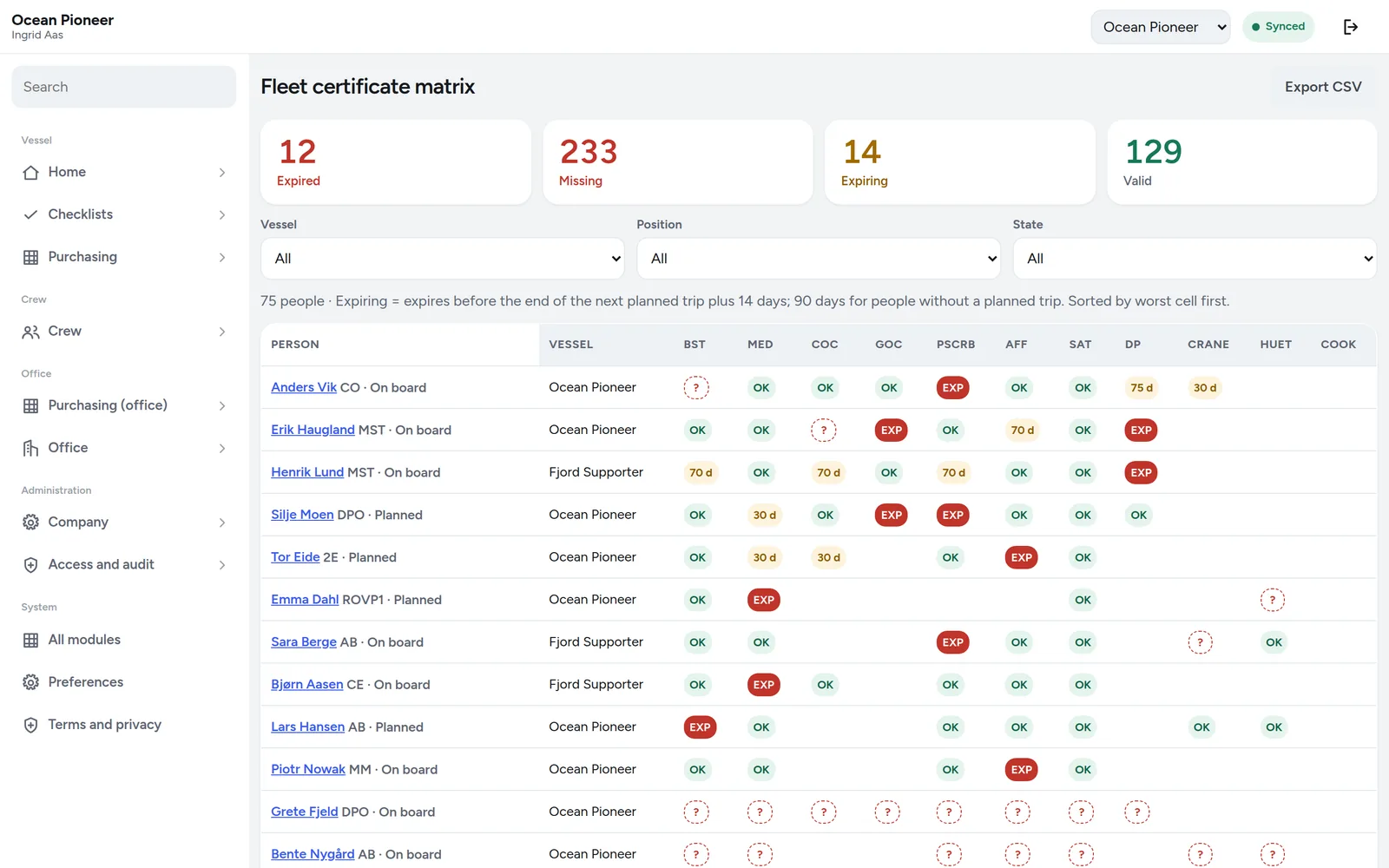
Who is on board, what each position must hold, and which certificate expires before the crew change.
FOR-2011-12-22-1523 04Work and rest hours
The daily record, the master’s review and the KS-0300 print, with every breach flagged as the rule that was broken.
FOR-2007-06-26-705 § 10 05Checklists
The daily, weekly and monthly checks on board, with versioned wording and no duplicated occurrence when two devices are offline.
ISM Code, clause 7 06Handovers and forms
One form engine behind every signed piece of paper on board, with the wording frozen at the moment of signature.
ISM Code, clause 11 07Drills and exercises
Statutory drills per shift and per person, with the departure check that says whether this crew may sail.
SOLAS III/19.3.2 08Permit to work
Hot work, height, enclosed space and general permits, with the isolations, the toolbox talk and the risk assessment attached to the job.
Offshore Norge 088 09Defects and observations
One button to report a defect or a safety observation, from any screen, by anybody on board.
ISM Code, clause 9 10Oil Record Book
Part I kept electronically, with entries that cannot be altered after signature and a true copy that prints.
MARPOL Annex I, Reg. 17 11Operations log and daily report
Port calls, activity, the daily report to charterer and owner, and the Garbage Record Book.
MARPOL Annex V, Reg. 10 12Consumption
Fuel, lube oil and fresh water as a ledger, so the balance is derived rather than typed.
Bunker delivery note 13Dynamic positioning
The DP log, the capability plan, versioned DP checklists and an event report that does not wait for the office.
MSC.1/Circ.1580 14Purchasing
Requisition to receipt, on the shipowner’s own thresholds, where nobody approves their own commitment.
The shipowner’s own policy 15Medicine chest
The chest, the controlled-drugs control book, treatments given and the annual expert inspection.
FOR-2001-03-09-439 16Messaging and notices
Person to person, office to fleet, and a notice whose acknowledgements are counted per version in force.
Arbeidsmiljøloven § 9-5 17Gangway and ship security
A tablet at the gangway that signs people on and off, logs visitors, and shows who is on board right now.
FOR-2004-06-22-972 18Accommodation
Decks, cabins and berths, who sleeps where, and the cleaning record — tied to the watch so nobody is woken.
MLC 2006, Regulation 3.1 19The fleet office
Every vessel on one screen, the certificate matrix across the fleet, the rotation planner and the relief pool.
ISM Code, clause 12