
Modules · 08
Permit to work
Hot work, height, enclosed space and general permits, with the isolations, the toolbox talk and the risk assessment attached to the job.
What it is for
The requirement
Offshore Norge anbefaling 088 — common model for work permitsThe Norwegian offshore industry’s recommended guidelines for a common model for work permits, currently at revision 06. On a supply vessel working a Norwegian field the charterer expects the shipboard permit to be recognisable as the same model the installation is using, which is a requirement no international convention states and every operations manager knows.
A permit to work is the only document on a ship where the sequence itself is the safety measure. Isolate, test, brief, authorise, work, restore, close — in that order, with different people at different steps, and no step skipped because it was late and everyone knew what they were doing.
This module encodes the sequence as a state machine, which means it cannot be skipped rather than should not be. A permit cannot be authorised before the gas test that its template requires. It cannot be closed while an isolation is still recorded as applied.
In detail
What the module does
- Four permit types, seeded and editable. General work, hot work, working at height and enclosed space entry, each with its own template, its own required tests and its own authorisers.
- Isolations signed on and signed back. Each isolation is a row with who applied it and who removed it. The permit will not close while one is outstanding, which is the failure mode that kills people.
- A gas reading that expires. An enclosed-space reading is valid for a stated period. When it lapses the permit says so rather than continuing to display a number from four hours ago.
- Toolbox talk attached to the permit. The talk is a form, held with the people who are doing the work, signed by them, and filed against the permit rather than in a folder.
- Locations from the vessel’s own register. A permit is raised against a space that exists on this ship — a named tank, a named room — not a free-text field that reads "engine room" in six different spellings.
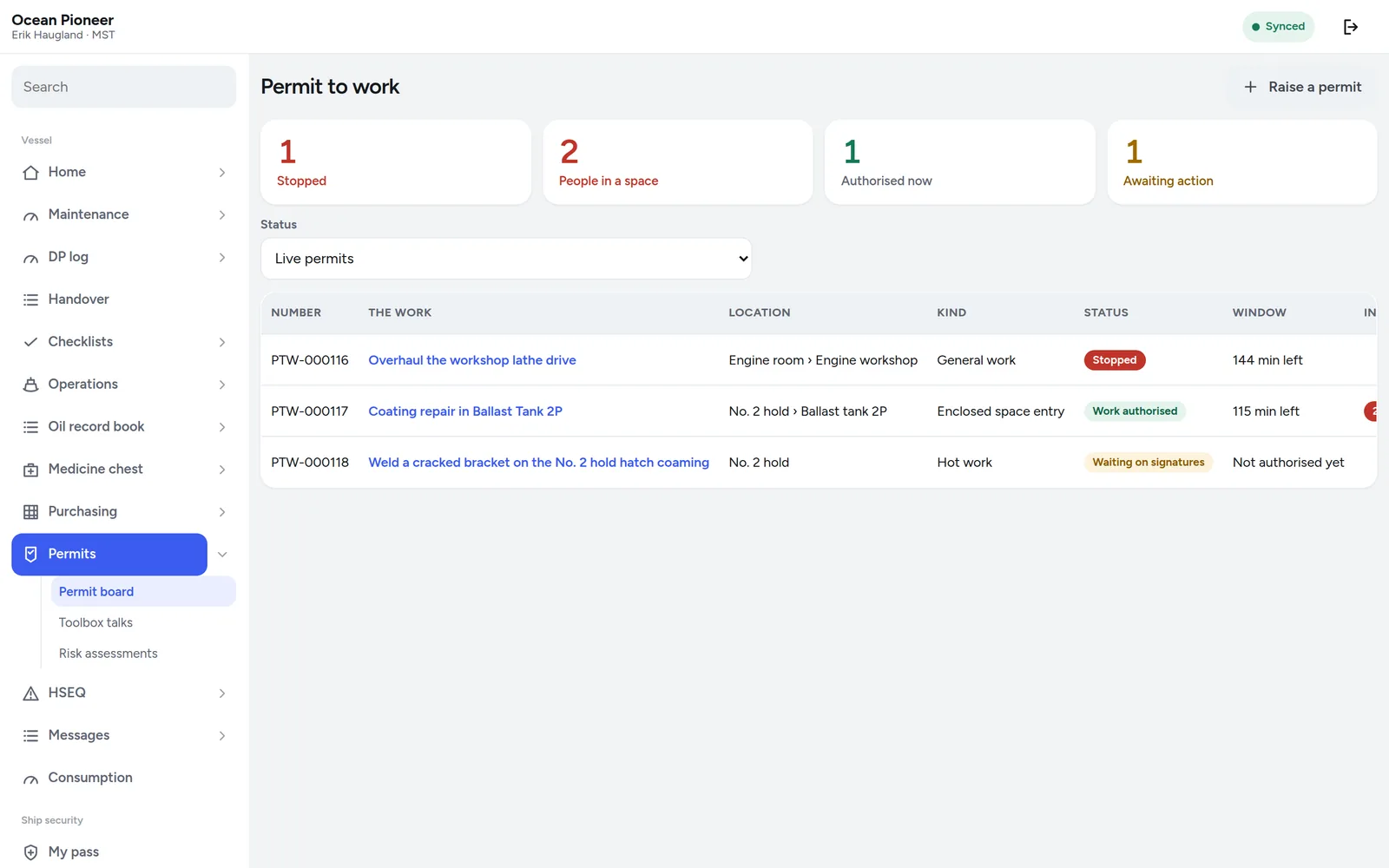
- The permit board. One screen showing every live permit, what is isolated, and what expires when. It is the screen the duty officer keeps open.
Screens
What it adds to the app
- Permit board — every live permit and what is isolated
- Raise a permit — the template, the tests, the authorisers
- Toolbox talks — held, signed, filed against the permit
- Risk assessment, reusable and versioned
The decision
The sequence is the product
It would have been faster to ship a permit as a form with seven signature boxes. It would also have been useless: the whole value is that the third box cannot be signed before the second, and a form does not know that.
The invariants are tested in the domain package, so the rule holds identically on a tablet with no signal and on the server when that tablet reconnects.